
Many patients and their family members ask an important question before deciding on surgery:
“What is the success rate of spine surgery in Dhaka?”
The answer is not as simple as giving a percentage. The success of spine surgery depends on several important factors, and understanding these factors helps patients make informed decisions and achieve the best possible outcomes.
As a spine surgeon, I always explain to my patients that the success of spine surgery does not depend solely on the operation itself. Instead, it depends on a combination of proper timing, correct diagnosis, appropriate surgical indication, hospital facilities, surgical expertise, and the patient’s commitment to postoperative care.
In this article, we will discuss the key factors that determine the success of spine surgery and what patients can do to maximize their chances of recovery.
Is Spine Surgery Successful in Dhaka?
Yes, spine surgery can be highly successful when performed for the right patient, at the right time, and for the right indication.
Modern spine surgery techniques have significantly improved patient outcomes over the last few decades. However, patients should understand that there is no single “success rate” that applies to every spinal condition or every patient.
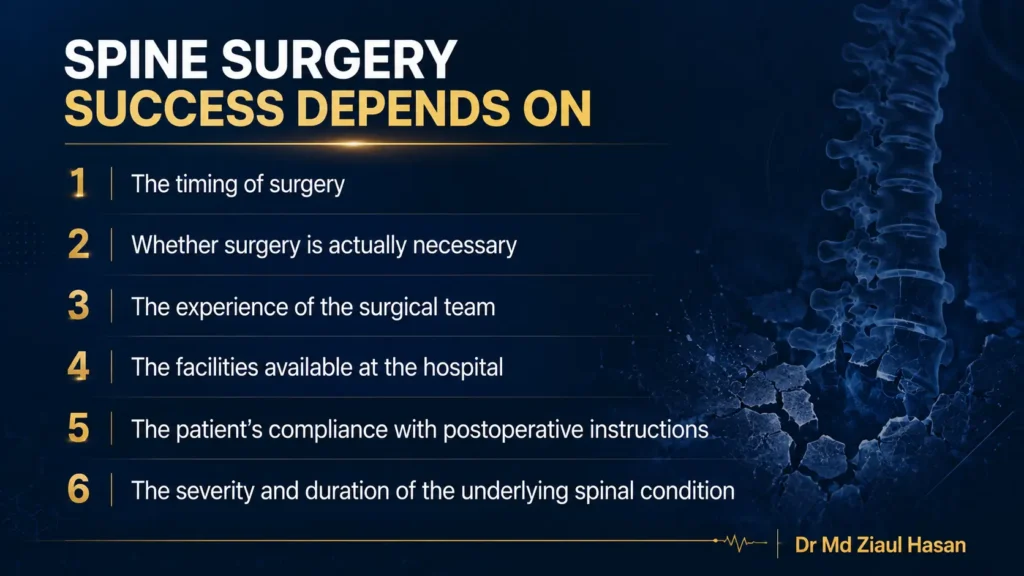
The outcome of spine surgery depends on multiple factors, including:
- The timing of surgery
- Whether surgery is actually necessary
- The experience of the surgical team
- The facilities available at the hospital
- The patient’s compliance with postoperative instructions
- The severity and duration of the underlying spinal condition
1. Timing of Surgery: One of the Most Important Factors
One of the most important factors affecting the success of spine surgery is when the surgery is performed.
Many patients delay surgery due to fear, uncertainty, or the hope that symptoms will improve on their own. While conservative treatment is appropriate for many spinal conditions, delaying surgery when there is a clear indication can sometimes reduce the chances of complete recovery.
This is especially important in patients with:
- Progressive weakness
- Spinal cord compression
- Significant nerve compression
- Spine fractures and instability
- Progressive neurological deficits
Early intervention, when indicated, often provides better outcomes and helps prevent permanent damage.
A good example of this principle can be seen in our patient who underwent ACDF surgery for a C5-C6 cervical spine fracture, where timely surgical intervention played a crucial role in recovery. (Internal link: Successful ACDF Surgery in Dhaka Bangladesh | C5-C6 Fracture | Importance of Early Surgery in Spinal Injury Recovery)
2. Surgery Should Only Be Performed When It Is Truly Necessary
Another major factor influencing the success of spine surgery is ensuring that the surgery is actually needed.
Not every patient with back pain, neck pain, or a disc problem requires surgery. In fact, many spinal conditions can be managed successfully through:
- Medication
- Physiotherapy
- Lifestyle modification
- Exercise programs
- Conservative management
Performing surgery without proper indication often leads to unsatisfactory results.
Therefore, before recommending surgery, it is essential to conduct a thorough clinical evaluation, correlate symptoms with imaging findings, and determine whether surgery will genuinely benefit the patient.
Proper patient selection remains one of the strongest predictors of successful spine surgery outcomes.
3. Hospital Facilities and Surgical Infrastructure Matter
The success of spine surgery also depends on the quality of the hospital and the facilities available during treatment.
Important factors include:
- Modern operating theater facilities
- Advanced imaging support
- Appropriate surgical equipment
- Experienced anesthesia team
- Trained nursing staff
- Infection prevention protocols
- Postoperative monitoring and rehabilitation support
A well-equipped hospital environment significantly contributes to patient safety and successful recovery.
4. Following Postoperative Instructions Is Essential
Many patients believe that once the surgery is completed, the treatment process is over. However, postoperative care is often just as important as the surgery itself.
After spine surgery, patients should carefully follow all medical advice, including:
- Taking prescribed medications
- Following activity restrictions
- Attending follow-up appointments
- Participating in rehabilitation when necessary
- Maintaining proper posture and lifestyle habits
Patients who follow postoperative guidelines consistently often achieve better outcomes and faster recovery.
Real-Life Example: Successful Recovery After Lumbar Disc Surgery
We have seen many patients return to their normal lives after successful spine surgery when all the factors discussed above are addressed properly.
One example is our patient who underwent successful surgery for Prolapsed Lumbar Intervertebral Disc (PLID) and achieved significant recovery after appropriate surgical treatment and postoperative care. (Successful PLID Spine Surgery in Dhaka Bangladesh by Dr MD Ziaul Hasan | Patient Case)
These real-life experiences remind us that successful spine surgery is not simply about performing an operation—it is about providing the right treatment, at the right time, for the right patient.
See the patient recovery documentary:
Patient Story: How Early Surgery Helped a Young Patient Recover After a Cervical Spine Injury
A recent patient case from our practice demonstrates why the timing of spine surgery can significantly affect recovery outcomes.
A 20-year-old female patient was admitted after a road traffic accident with a severe C5-C6 cervical spine fracture-dislocation, causing spinal cord compression and significant weakness. Because the injury was identified early and surgical treatment was performed without unnecessary delay, the patient showed remarkable recovery during the immediate postoperative period.
Following Anterior Cervical Discectomy and Fusion (ACDF) surgery, she was able to sit and take oral food on the first postoperative day. By the second day after surgery, she was walking independently without support and was even able to climb stairs comfortably.
Watch The Full case here:
This case highlights an important principle in spine surgery: when spinal cord compression and neurological deficits are present, timely diagnosis and appropriate surgical intervention can play a critical role in maximizing recovery potential and preventing long-term complications.
About the Author

Dr MD Ziaul Hasan is an Orthopedic, Spine, Trauma Specialist and Surgeon currently serving at the National Institute of Traumatology and Orthopaedic Rehabilitation (NITOR), Bangladesh.
Dr Hasan specializes in the diagnosis and treatment of spinal disorders, spinal trauma, degenerative spine diseases, disc prolapse, cervical and lumbar spine conditions, and complex orthopedic trauma. Through clinical practice, patient education, and evidence-based treatment approaches, he aims to help patients make informed decisions regarding their spine health.
This article is based on Dr Hasan’s clinical experience and patient counseling regarding the factors that influence the success of spine surgery and postoperative recovery.
Medical Disclaimer: This article is intended for educational purposes only and should not replace professional medical advice, diagnosis, or treatment. Treatment decisions for spinal disorders should always be made after consultation with a qualified spine specialist.