(Advanced Spine Tumor Care by Dr. Md. Ziaul Hasan)
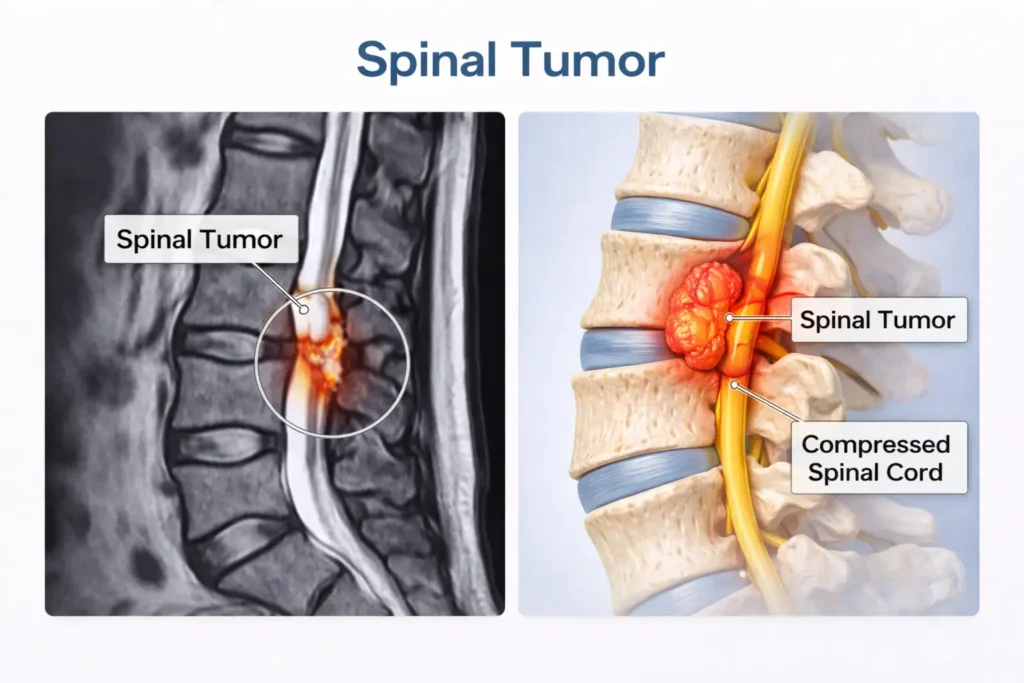
A spinal tumor is an abnormal growth of cells that develops in or around the spine. It can occur:
Inside the spinal cord
In the protective covering of the spinal cord
In the vertebra (spinal bones)
Or spread to the spine from another part of the body
Spinal tumors may be benign (non-cancerous) or malignant (cancerous). Even benign tumors can cause serious problems if they compress the spinal cord or nerves.
Early diagnosis and treatment are extremely important to prevent permanent nerve damage.
These start in the spine itself.
Examples:
Osteoma
Meningioma
Nerve sheath tumors
These spread to the spine from other cancers such as:
Breast cancer
Lung cancer
Prostate cancer
Metastatic tumors are more common than primary spinal tumors.
Symptoms usually develop gradually but may worsen over time.
Patients may experience:
Persistent back pain (especially pain that worsens at night)
Pain that does not improve with rest
Weakness in arms or legs
Numbness or tingling
Difficulty walking
Loss of bladder or bowel control (serious condition)
Unexplained weight loss (in some cancer cases)
If neurological symptoms appear, urgent spine evaluation is necessary.
While the exact cause is not always known, risk factors include:
History of cancer
Genetic conditions
Weakened immune system
Exposure to radiation
Modern diagnosis includes:
MRI scan of the spine
CT scan
X-ray
Biopsy (if required)
MRI is the most important imaging test for detecting spinal tumors and nerve compression.
Treatment depends on:
Type of tumor
Size and location
Whether it is benign or malignant
Degree of spinal cord compression
Patient’s overall health
In selected cases:
Radiation therapy
Chemotherapy
Targeted cancer therapy
Pain management
Surgery is needed when:
There is spinal cord compression
Progressive weakness is present
Severe pain persists
Spine instability develops
Modern spine tumor surgery includes:
Advanced surgical techniques now allow:
Better nerve protection
Improved tumor removal
Faster recovery
Reduced complications
Spinal tumor surgery requires high-level spine expertise and trauma experience.
Dr. Md. Ziaul Hasan is a fellowship-trained Spine, Orthopedic & Trauma Specialist with advanced training in minimally invasive and complex spine surgery. He provides:
Evaluation of spinal tumors
Surgical decompression
Spinal stabilization procedures
Multidisciplinary treatment coordination
Early consultation significantly improves neurological outcomes and quality of life.