
(Expert Care by Dr. Md. Ziaul Hasan – Spine, Orthopedic & Trauma Specialist)
A spinal fracture is a break or crack in one or more of the vertebrae (bones of the spine). It can affect the neck (cervical spine), middle back (thoracic spine), or lower back (lumbar spine).
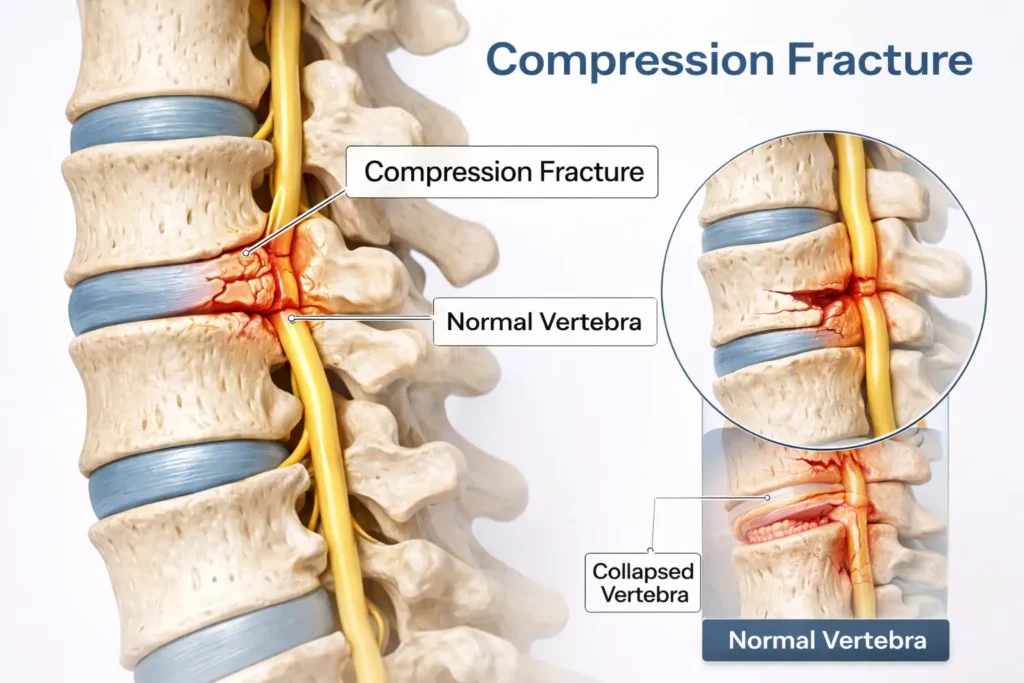
Spinal fractures can range from minor compression fractures to severe unstable fractures that may damage the spinal cord or nerves.
If not treated properly, spinal fractures can lead to:
Severe back pain
Nerve weakness or paralysis
Spinal deformity
Long-term disability
Early diagnosis and proper management are very important.
In Bangladesh, spinal fractures commonly occur due to:
Motorcycle and car accidents are one of the leading causes of severe spinal injuries.
Construction workers, electric pole workers, and accidental rooftop falls are very common causes.
In older adults, especially women, weak bones can cause spinal compression fractures even after minor falls.
Falling heavy loads in workplaces or industrial accidents.
Because of these causes, spinal fracture management requires both trauma expertise and spine specialization.
Compression Fracture – Bone collapses due to pressure (common in elderly)
Burst Fracture – Vertebra breaks in multiple directions (often from accidents)
Fracture-Dislocation – Bone fracture with spine misalignment (serious injury)
Severe cases may involve spinal cord compression requiring urgent surgery.
Patients may experience:
Sudden severe back pain
Pain that worsens with movement
Numbness or weakness in legs
Difficulty standing or walking
Loss of bladder or bowel control (emergency sign)
If neurological symptoms appear, immediate spine consultation is necessary.
Treatment depends on:
Type of fracture
Stability of the spine
Presence of nerve compression
Patient age and bone condition
For stable fractures:
Pain medication
Spine brace
Bed rest (short duration only)
Physiotherapy and rehabilitation
Osteoporosis management
For unstable fractures or nerve involvement:
Small incision techniques with less muscle damage.
Modern spinal instrumentation to stabilize the fractured bone.
Cement injection procedures for compression fractures.
If nerves are compressed.
Modern spine surgery now allows:
Faster recovery
Less blood loss
Shorter hospital stay
Early mobilization
Spinal trauma requires both orthopedic and advanced spine expertise.
Dr. Md. Ziaul Hasan is a Spine, Orthopedic & Trauma Specialist with advanced fellowship training in minimally invasive and endoscopic spine surgery. He manages:
Traumatic spinal fractures
Osteoporotic compression fractures
Complex unstable spinal injuries
Surgical and non-surgical spine trauma cases
Early evaluation significantly improves outcomes and reduces complications.